All Who Are Weary and Heavy Laden, I Will Give You Rest
Available as live performance, video installation with stereo, video installation with 8 channel audio, or 8 channel audio installation.
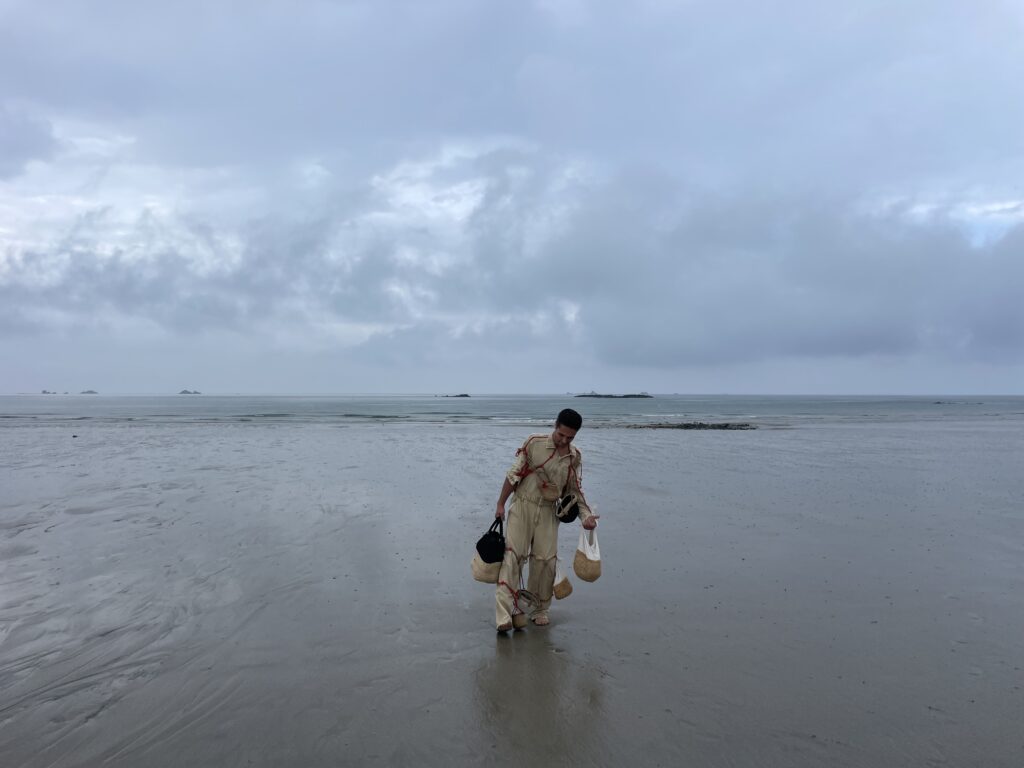
The paradox of the disabled burden.
We carry a weight, that no matter what we do will not be lifted.
The weight manifested by society, is projected upon us.
We are stopped at invisible and visible barriers,
Requested to provide the commensurate paperwork
which proves we have a right to exist,
but only at poverty level.
God forbid a disabled person should live a happy life
unblighted by fear, poverty, isolation, inspection, judgement and penalty.
And yet, is it I who is burdened?
For I hear that it is I who is a burden,
I should unburden those around me by removing myself from existence.
I hear that society would be better without the burden that is the sick person.
My loved ones freer, the state better off.
This is the sickness, we carry
alongside anything biomedical which may be occurring.
This is the weight which we cannot lift.
Placed upon us, because we do not fit within the bell curve of “normal”.
Our bio-contribution is not enough to lift us from this societal burden.
We are the stones in the pockets of a drowning economy.
Weight added can add up to a leverage, unless there is a lack of infrastructure to support it.
Introduce a weight into a one and you will find immediate destabilization and consequent crumbling of the structure that supports the one, one might even say, that is what one is. However, one is a malleable entity. It can swiftly counteract the intense increase of the leverage put up by added weight. One does it by imposing a countermove of investing enough energy to support the new way of balance and, accordingly, function. One more however is however to be mentioned: the however of the one that can function only within the confines of the society, and if the lack of infrastructure is within the within, the one is given a dead weight.
Society is the ultimate leverage to the dead weight. However, society without an infrastructure is a dead weight itself. The one with the weight of disability is anchored by it, and then, we can forget or be truly cynical about the abstract way we dealt with it in the beginning and scroll to the last bit. And that is: balancing anew is not a disability, it’s a reformation.
During the performance, audience members will be asked to symbolically lay what is burdening them into a stone and give it to Boško to carry. The stones will range from tiny to large. Boško will symbolically take their burden from them and continue with his tasks. His costume will have a series of strangely placed pockets, and as he fills these his body will be strangely weighted, unbalanced and uncomfortable. His body suit also creates rattles and cracks as the stones move around in the pockets. This sound is added to the soundscape of the voices speaking about burdens.
The work examines notions of exhaustion, interdependence, care, isolation, mental health and inclusive design. Together, Boško and Amble have focussed on exploring interdependent collaboration, where Boško’s movements send data to her laptop. In this way both artists are entirely reliant upon the other to create a work; everything is interlaced and balances between the two art forms.
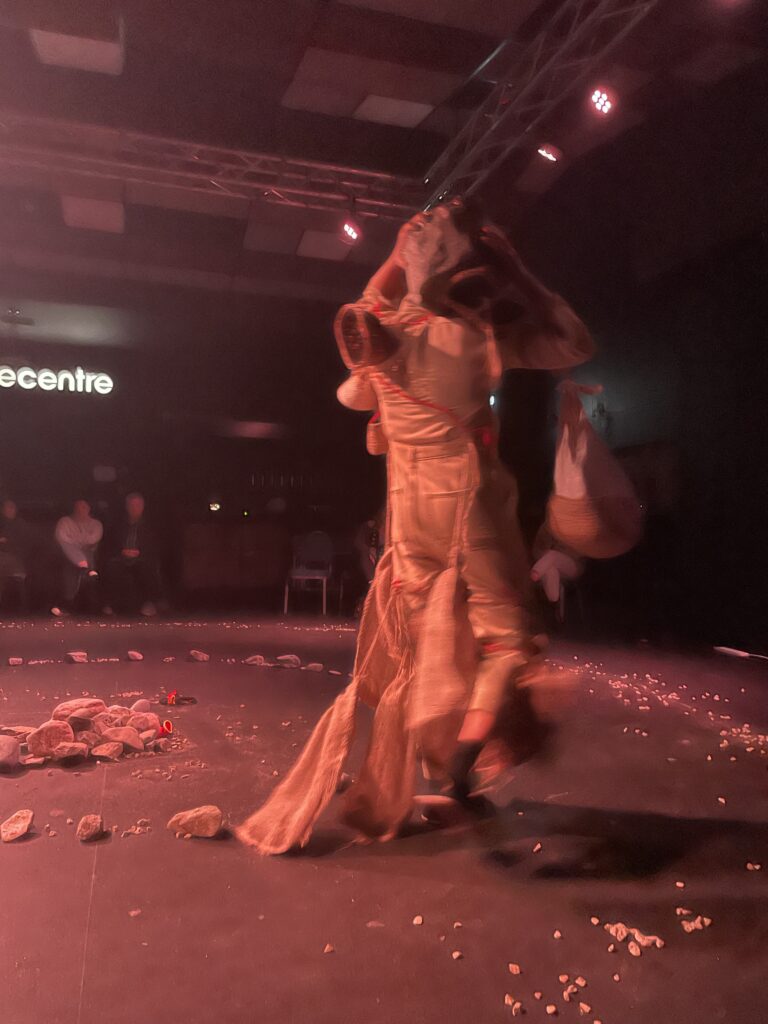
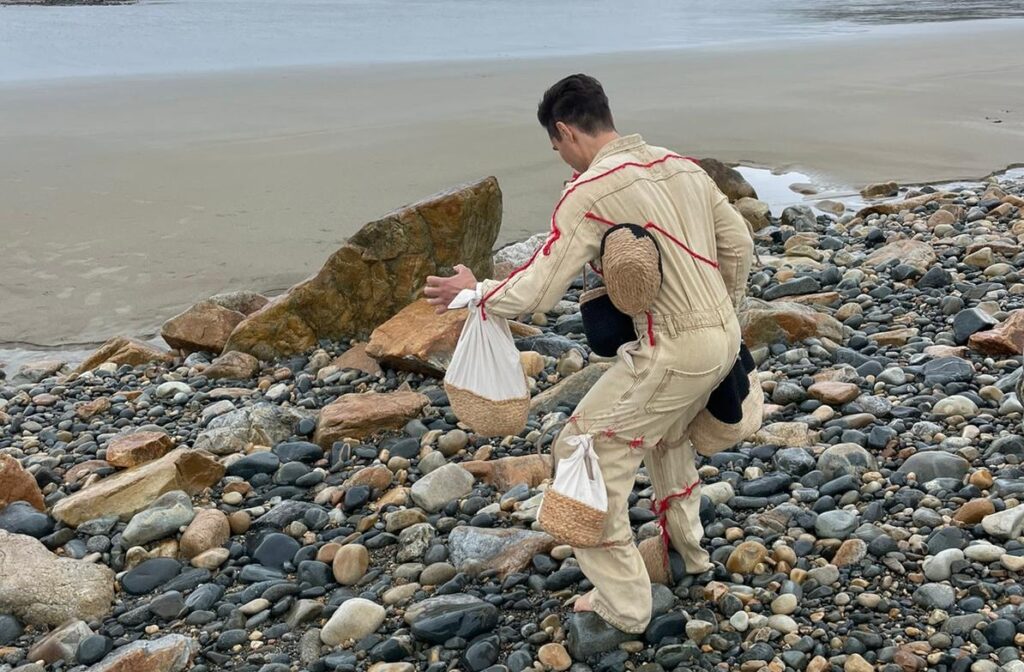
Boško’s work explores movement as the core of being human. In this context his work is very interesting from a disabled perspective. In this work he explores what happens to a body which is burdened, where weight and strength are not equally distributed, by opening himself to the audience both for adding weights to his body, and giving him tasks to undertake he entrusts his body to strangers. The safety of his movement, any adjustments, compromises, failures and falls will be real, and made in real time in front of the audience. In opening himself up in this way, Boško demonstrates an empathy for what it is to be disabled.
This piece has multiple layers, covering issues such as the connection with “wellness and goodness”, doing tasks for friends who are over burdened, confession as an unburdening, notions of masculinity as related to physical strength, and what it does to a human when their body fails them.